Thursday, March 1, 2012

“They Scorched the Snake But Have Not Killed It,”

was Banquo’s whispered plea. I wish I could remember what else he said to me with such intensity when he locked me in that room with the simple wooden furniture. The servant’s quarters. A bare alter and a bed. I was a woman he used to know. It was so good to see me again. He anointed me with oil and assured me that I was chosen for some great purpose. I was silent, as I had been instructed from the beginning. But he lifted my mask off and I guess my eyes were big as saucers. Wide open because nothing feels as good and as terrifying as surrendering your reality.

I knew what I was getting into, or I thought I did, when I lined up outside the McKittrick Hotel in Chelsea to see ‘Sleep No More.’ I had brushed up on my Macbeth the night before. But the vibrant, violent world than greeted me inside was far more realized than I could have hoped for.

The anti-chamber helps. A winding, light-less hallway spills into the holding pen where revelers start and end their nights. This space is a functioning jazz bar where guests mingle with each other, throw off their old-worldly cares and get a taste of the new reality (absinth-flavored) before being subsumed. It is an effective transition to the surreal, because although the year is suddenly 1930, the jazz singer is a jazz singer and the champagne is champagne.

Inside, the first thing that hits you is that people can move differently in this world; there has been some shift in the physical laws. We’ve all seen dance performances before, but these people can climb walls, they can fall in and out of possessed states, they can fairly fly around the room. They have obviously been swept up in a super-human storm led by forces that are out of their control. The witches can read but not change them. It is this volatile combination of elements that makes the Macbeth story just as potent four hundred years after its birth.

The occupants of the McKittrick Hotel are tormented by guilt and wracked with lust. They hurl their bodies at walls and each other with wild abandon. The brutal percussion of all the falling, slamming, punching, shoving, growling, panting, clawing and lunging starts to keep beat in your ribcage like the baseline at a rock concert.

The question is not “Do I believe?” but rather, “How deep down this rabbit hole can I fall?”

The voyeurs are ghosts -- observing silently from beneath identical, white masks. But at least we are on the same side of the looking glass as the action and can haunt the performers at will. It is refreshing to be able to bodily respond to a physical performance, to empathize with and echo an inspiring movement, to chase down something that catches your fancy.

Once I climbed through the window of a mental hospital ward and landed in a forest. The fog that snaked through the labyrinth of braided trees was glowing ultramarine. The space was big enough so that the corners of the room could disappear in blue clouds. I wandered alone for a while until I stumbled onto a cabin where a nurse was reading quietly at the window, her hut scaled on the inside with thousands of hospital records butchered like clumsy snowflakes.

Because I’m hopelessly insatiable when it comes to dream worlds and alternate realities, I had a hard time dragging myself away from that glitzy jazz bar at the end of the night. A sultry singer with a septum piercing and a sequined gown like a second-skin was crooning. A guy was asking me to explain Macbeth to him one more time. The performers were emerging to unwind for the night.

I asked the male witch, “Have you read the night circus?” He was beautiful and willowy, with distinctive dark eyeliner. His character was the provocateur, the button pusher, the tempter, the hedonist, the spark that set stuff ablaze. I had just seen him naked with a giant bull’s head on, dancing feverishly, leaping onto tables with blood running from his belly down his stomach to the curve of his thigh. I had just watched Macbeth kneel beneath him and lick it off as a strobe light and a screaming techno beat tore threw any last remaining inhibitions or distance we had between ourselves and the soiled fabric of everything else. “Of course!” he said enthusiastically. “The author saw the show in Boston a while back. I think it gave her a lot of ideas.”

Then I thanked Banquo for the anointment. “Oh you!” He was pleased to see his silent ghost in the jazz bar of the half-alive. In purgatory. In ‘The Restaurant at the End of the Universe’ (in which the Big Bang starts over from scratch again each night). He was trying to catch the last train, so we ended up walking to the subway together, climbing down different staircases and standing across from each other on the platform. As I am physically incapable of turning away from magical potential, I watched him until he got onto his train. He walked to the window, put his hand on the glass and held my gaze until he was swallowed by the tunnel.

I swore the scented oil on my palms was bleeding into the stale subway air. Or some of the witch’s calcite clung to my hair because, the whole way home, people kept coming up to me, asking me about this or that, directions, where I was from. They could tell I’d been elsewhere. If we had all been dining at the Restaurant at the End of the Universe, they would have told their waiter, “I’ll have what she’s having.”

Friday, February 10, 2012

Goldfish Grow to Their Corners


Geoff oggling Mimi's guest bedroom.

I recently visited the studios of two artists. Feisty, redheaded ladies with insatiable appetites for silliness and adventure and a lust for the brightest colors they can get their hands on. They are the kind of effortlessly generous women that can hardly find enough lucky targets to pour their affection onto. Both are figurative painters whose work walks right off the canvas and into the social sphere with life-sized portraits of friends and art scenes and the ways we gather. Sometimes their canvases even warp, grow a third dimension and morph into walls and installations. Neither artist finds reason to separate life from work so, as a friend of theirs, you’re never quite sure when you’re being framed.

Why bother to differentiate art vs a dinner party? (Painters from left: Mimi, Laini Nemett, Ellen Schneiderman, Geoffrey Miller)

They are also at opposite ends of their careers -- Laura looking up from her just-sprouted practice and Mimi looking down over her tall, lush one that bears strong, intricate branches and encases many concentric rings.

Mimi's.

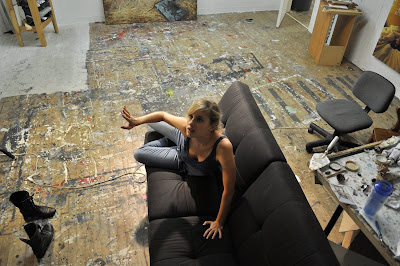
Oh. And both Laura and Mimi have big live/work spaces (as pictured in all of these photos), which is the reason I thought to write about them together in the first place. Huge. The word “cavernous” comes to mind and can’t be shaken.

Mimi's studio space.

Mimi Gross spent a chunk of her twenties traveling around Italy in a horse-drawn carriage, supporting herself hand to mouth with puppet shows performed out of the back. She’s shot the shit with just about everyone you’ve read about in your 20th century art textbook. Her stories of travel and art world exploits are endless and spellbinding. It’s hard to fathom all that she’s seen and shaped and loved and left behind.

Early portrait of Mimi.

The one piece Mimi did about her travels in Berlin. A light box diorama. Simple and a bit slapstick -- I was immediately brought back there and felt the weight of the city in the paper construction that must have weighed next to nothing.

She has lived and worked in this giant flat in Manhattan for (I believe) over 30 years. The walls are stacked salon style to high ceilings with bright, bold art that documents and fictionalizes so many pasts it’s dizying. And the other half of the space is all new work – her studio. I think what leaves me most in awe of Mimi, and it’s quite a list to top, is the freshness of her palette. Her studio is like an enormous, overgrown garden. The new work climbing up the walls, ceiling and floor, is obviously on some sort of super fertilizer.

The bedroom portion of Laura's room.

Laura Hudson, who graduated from MICA’s MFA program with me last May, is discovering and staking out for the first time the territory that will be hers to mine and build on. Like me, she has little more than instinct and the voices in her head (painting teachers, the elder art gods, buddies, favorite musicians, Tom Bombadil (that could just be me)) to guide her to strange new lands. At this point the path seems arbitrary and disjointed, but I have a feeling that when she looks back over her travels, the path will show itself to be patterned with purpose and direction. Laura is someone who is sensitive enough to feel the pull of her “true North” and bold enough to follow it blindly.

The studio part.

She chose to stay in Baltimore after she graduated in large part because of the space she lives in, one of the rooms in the H&H Building – a vital organ of Bmore’s grassroots art and music scene, housing 3 galleries and 2 music venues (the count changes weekly). The show that is up now at Gallery Four, Laura’s floor, “Cowboys and Engines” by Dustin Carlson, stakes out the vast, industrial space brilliantly. The director of the Baltimore Museum of Art told me that she thought it was one of the strongest shows she’s seen, anywhere, in years.

Laura's door opens onto this.

Laura has a solo show coming up at the Arlington Arts Center in Virginia in the fall and, to prep, they let her throw a sleepover party in the space. She filmed it and is plotting life-sized paintings of the revelers that she will hang for the opening as a similar crowd fills the room.

And then this.

And finally this.

Sunday, February 5, 2012

Fight for Me


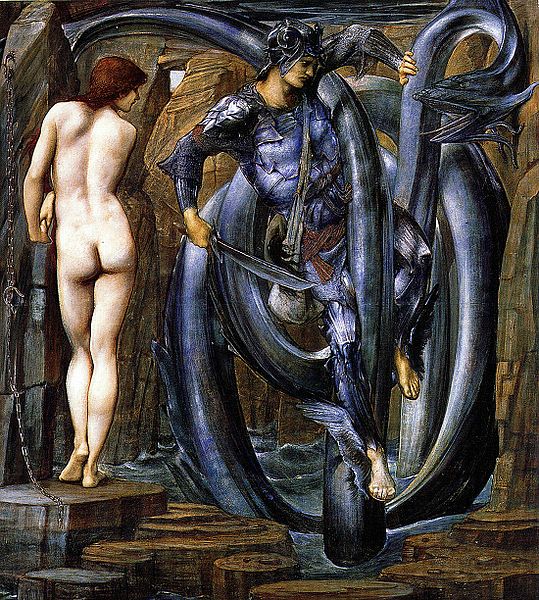
Perseus slaying the dragon and freeing the maiden by Edward Burne-Jones.

If you want to marry my daughter, you’re going to have to find the ring I’ve dropped into the middle of the Red Sea. If she is your heart’s desire, you will have to find the secret place where she goes to dance each night. You must beat her in a race, even though she plays dirty. You must eat 300 oxen -- skin, bones and all -- and then drink 100 casks of wine in one night. If you fail in this, I will cut off your head. But if you succeed, the kingdom and the most beautiful bride will be yours.

The Grimm brothers recorded more than a few of these deadly trials. The common fairytale trope works to prove the strength and dedication (love never seems to factor in) of the competitor to the one in possession of his object of desire. It also impresses upon our protagonist the weight of what he’s getting himself into. And it’s not all boys slaying dragons (although it’s a lot of boys slaying dragons). If you happen to be a girl, you can line up outside the castle to present yourself as the most beautiful maiden in the land. If you win, the kingdom is yours. But if you are outshined, you will be drowned in the lake.

Brutal, right? Trial by fire with the highest of stakes. But isn’t it preferable to sitting at home and mailing letters into the void, checking the horizon for a horse-backed messenger every morning for months, not even sure if your courier was waylaid by bandits or delayed in a tavern of ill repute? Isn’t it better than biting your nails down to and past the quick and venting to anyone that will listen that if you could just see the princess, just for a moment, if you could entertain her with stories about your travels to the East and play her that new song on the lute and if she could just see the way this season’s harvest has made your body strong and tan then she would choose you above all the others? Instead of cursing the advantage of men whose fathers are close with the King and can bypass all that red tape, wouldn’t it be better to have the chance to win or lose her on your own merit?

I thought about this a lot when I returned from the Vermont Studio Center to my parents’ house in Connecticut this November. I spent a few days converting the basement into a studio space and then dove headlong into a stream of job applications. (A one-way stream, which carries time and effort and carefully crafted sentences away from you at a very fast pace and returns nothing but new waters.) There has been a lot written lately about how hard it is for us young folk to find jobs, especially in creative fields. The market, especially in New York, is saturated with academically decorated, creative minds and there’s just not that much money in the arts to go around.

After a week of sending out email after email into the web abyss, I spent a day in North Hampton with an artist friend. I was walking his dog, which looked like a tiny, toy luckdragon, down a bustling street and I was afraid someone was going to step on it. Its bones as delicate as a bird’s. “I wish I could just fight a dragon,” I said.

“Huh?” Don said.

“Sometimes I wish I could just fight a dragon or find some really far away herb or walk through a burning forest in some epic, bloody trial to get a job. And if I didn’t make it, fine. But at least I would have a chance to fight for what I want instead of sending out all of these faceless emails.”

“I think you’d be good at fighting a dragon,” he said.
“Thanks. Can I use you as a reference?”

Anyway, “Be careful what you wish for,” etc. etc. I got a call soon after from an artist’s studio. I’ve been a huge fan of this woman’s work and philosophy for years. They asked me to come in and work with a team of assistants to fabricate a large-scale installation. It was pitched as a trial period for a permanent position. I made it sound like I was already in NY, so when they asked if I could start the next morning, I said “Sure!”

In progress installation.

It was already dinnertime, but I called a true friend in Brooklyn (“Can I move in with you tonight and stay with you for an unknown length of time?”), packed in an hour and a half, and worked a seven-day week. It turned out when I got there that the permanent positions were already full. But, long story short, there have been many challenges, obstacles, puzzles and riddles to work through as an assistant. I am still at the studio and, although I don’t know how long it will last, it’s good to know that I’ve had the chance to prove my mettle.

Weaving gold tinsel.

Sunday, December 25, 2011

The Longest Nights


Winter Solstice at my grandmother's house in Houston.

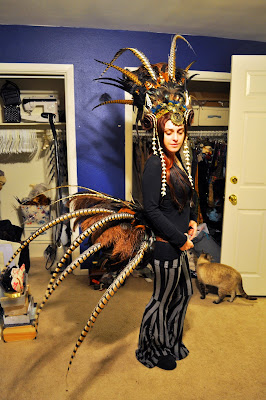
My cousin Mira -- belly dancer, painter, costume designer and body painter. She has a new project called Sirens where she transforms women with fabric, feathers and paint into their particular type of goddess. I drove to visit her on Friday southwest of Austin in a small town called Driftwood. I passed Enchanting Oaks Drive and Crystal Hills Drive. After a wooden sign proclaiming "Wizard Academy," I took a right turn onto her dirt driveway. Her studio sprawled across the ranch-style house with headdresses and Indian garb adorning every surface. A cushioned construction in the living room was shaping up into a hookah lounge. Three feline sentinels took turns keeping watch and bossing around her large dog.

Tuesday, December 6, 2011

Let’s Talk About Sets, Baby

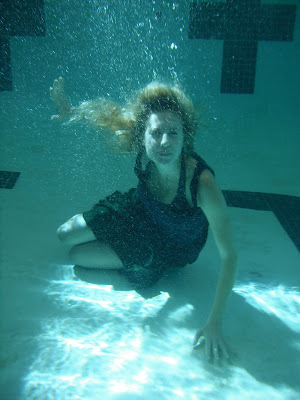
It’s a funny thing to build pretend worlds for the eye to trust and explore. Literally. There have been many funny moments -- stringing naked girls from impromptu crucifixes in my studio, burning model houses on private property, convincing your local YMCA lifeguard to let you into the pool with your clothes on and perform multiple costume changes. I would like to begin this post with a shout out to all my friends who have made my painting references possible. Procuring naked photos of oneself covered in broken glass isn’t something that a girl can get through all on her own. Here’s to you guys!

My flooded Baltimore bathroom.

So when I start a painting, the mental image almost always comes first. And if that happens to be something that I can handle translating from mind to matter without assistance, great, I’m off and running. But that is almost never the case. So I set up models or puppets in my studio to look at or people in a setting to photograph. Then I often suture these images together Frankenstein-style in my head. Every painting calls for a different method. (Necessity is the mother of invention, etc.) Nothing is “cheating” in my book. I’ve used tracing paper, printouts and projection. (However, during a critique with Julie Heffernan on a painting that drew from only one photo reference, her response was “Love the image. But wouldn’t it be horrible to make paintings like this all your life?” True story, Julie. Because although the process involved a much-reduced risk of an anxiety attack, it lacked the generative thrill that comes from birthing something new. And then, of course, if a photo adequately communicates an image, why make a painting?

Me in a skirt.

I end up using my own body a lot because I’m always around and am very supportive of my cause. I wish I could show you all of the bizarre imagery I have floating around in the ‘References’ folder on my computer – the pics are usually even more surreal than the paintings because the subject is often acting out something that clashes absurdly with its setting. But, unfortunately, many of the photos are un-postable because there are naked(!) people in them and we’ve all learned the hard way that once an image is out there, it’s almost impossible to reign back in. (For instance, the first image of me that pops up when you Google my name is a chubby-cheeked, Ms. Frizzle-esque catastrophe from my sophomore year in college. Dear Oberlin, I really appreciate the publicity. All press is good press, etc. etc. But, for the love of God, take that photo down.)

Each painting ends up gathering together a digital mood board of sorts, filled with images from all kinds of sources. I use this collection of internet detritus, mixed with video clips and primary sources, to figure out the composition, palette and desired feel of the piece.

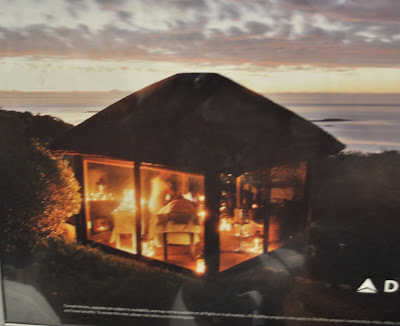
Delta advertisement that informed "Honey I'm Home."

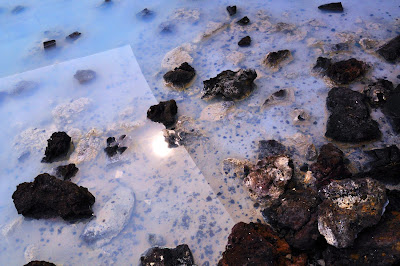
Especially since so much of my recent work stems from a specific place, my travel photos feed into my work directly. In Iceland, I kept a folder of images that I had collected as a color journal.


Sometimes all of the images are too much to combine in my head, so I physically cut them up and paste them together or do the equivalent on Photoshop.

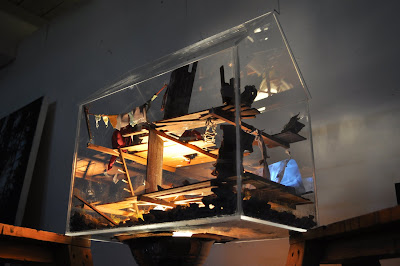
I owe much of my thesis work, “Outpost,” to a plexi-glass house. May it rest in peace. I had its components cut at a plastic company in Baltimore. I decorated the inside as one might a Robinson Crusoe style dollhouse, using model materials, furniture from my childhood dollhouse and random debris. It had a different role to play in each of my paintings. I had hoped one of those rolls would be a working aquarium. So I followed every Youtube step for making it water-tight. But it flooded my studio almost immediately. Since you can pass notes down to the floor below you in the Balitmore warehouse where my grad program was posted, I quickly scrapped that idea.

The house’s final act was a daring night stunt. Accompanied by three lovely female assistants, it was put afloat on a winter-cold river and set on fire. Apart from the toxic odor, it was a beautiful send-off. Afterwards, I tried to throw away its remains, but they were rescued by some of my more materially-experimental MFA peers and reincarnated as yet more art.

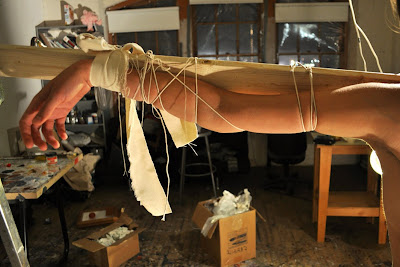
The best actress award goes to poet and neuroscience guru Ryann. The woman in my “Fielding Terns” painting was born from a combination of her body strung up in my studio and a puppet I constructed from material scraps. The forms ended up having a surprising amount in common.


These are images that came together to become “Everything That Rises:”


Most of my photos of Laura Hudson are not for the public eye! But luckily for you, her paintings are. (Be patient. They rotate through.)

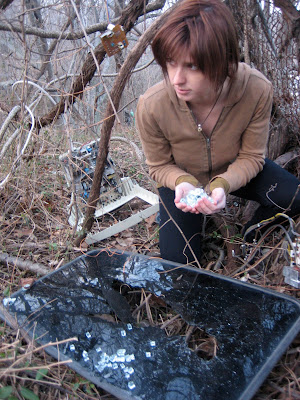
In which Chaney (an awesome painter and fellow adventure seeker) and I braved a tangled Baltimore underpass adjacent a sprawling homeless person’s shelter, shattered a sunroof that I had procured from a car graveyard and filled her hands with broken glass:


This is something that I am working from now. Kind of love this messy Photoshop collage so hopefully my painting will be at least as cool.

Monday, November 28, 2011

O, that I were a glove upon that hand


Looking in on a gallery opening at the Vermont Studio Center on a cold winter's night.

When I am feeling daunted by the uncertain road ahead to “artistdom,” I often look to artists I admire and am reassured by the stories of how they were able to make it work. Clare would question my logic in this. Clare, who is quoted in her sister Noreen Malone's Atlantic article, ‘The Kids Are Actually Sort of Alright,’ has some IM insight that begs a closer look:

CLARE: ok, you know what i always think about when i think of our generation? i read the david brooks book, “the social animal” and while it was only mediocre, he had this one really great bit that really stuck with me—the Greek ideal of “thumos”, which is the lust not for money or success (in the conventional sense) but the lust for glory


we want glory through our ideas-we want to know we matter 


(10:33) the cold truth is that not all of us are brilliant


we are not all big thinkers. Not everyone’s TED talks will change the world


some of us will just dissipate into the ether


(10:34) but it is the digital connectivity, that proximity to these people, that makes us think that perhaps we will succeed as well

We might not be able to get our hands on everything we dream up, but we can get our eyes on it (Romeo-style). Our idols and their creations are more accessible than ever. So what I want to know is, with our all-access passes to stellar minds and their accomplishments, are we any closer to achieving personal greatness in our own fields or do the examples just serve to taunt and tease?

I do think that the insights that we are privy to via social media can be useful in giving us a leg up in terms of technical know-how and career advice. Its advantages are clear if you think about the opposite extreme. Imagine trying to become a painter in the renaissance if you weren’t accepted into a guild. You wouldn’t have access to training, travel, mentorship or materials. Apprentices of master painters would have all the resources and you would be out of luck. Whereas, in this day and age, you can teach yourself just about anything you can type into YouTube.

In this way, the playing field is somewhat leveled. But are more people going to do something inventive with the surplus of resources? Or is the internet chatter just going to cancel itself out -- a bunch of white noise -- with the usual small percentage of unique voices standing out above the rest?

Sometimes it’s painful to read firsthand accounts of startups and starlets and artists who have hit the big time. We don’t just know them from their rare public appearances anymore. We get to read their daily thoughts, become familiar with their shorthand and receive messages from them on our personal phones. The illusion is that this brings us closer. But the major-league baseball player that my friend follows on twitter is not invested in her. (Sorry girl! He’s just not that into you.) There’s no reciprocation.

Tantalus wanted in with the gods. His father was Zeus, so he was above your average mortal stock and got a dinner invitation to Mt. Olympus one day. In order to impress them, Tantalus sacrificed his son and served pieces of him as the main course. When the Gods found out what he’d done, they were repulsed and banished him to the special part of Hades reserved for really bad guys. He was forced to stand in a pool of water underneath a fruit tree and for all eternity be tantalized by their proximity. Whenever he reached for a fruit it would move just out of his grasp and when he bent down to drink, the water would drain.

I realize this is a downer metaphor for reaching for the stars, but I found it useful in fleshing out Clare’s observation. Personally, I am optimistic that our proximity to great things will wet our palates (and palettes), spark some healthy competition and connect us with other people thinking similarly. For instance, I have developed the (hopefully not too annoying) habit of writing people whose work inspires me and thanking them for making awesome things. It is pretty easy to find email addresses and many of them write me back and are supportive of my work. This doesn’t mean that they impart any special success potion, but I do find it affirming and energizing.


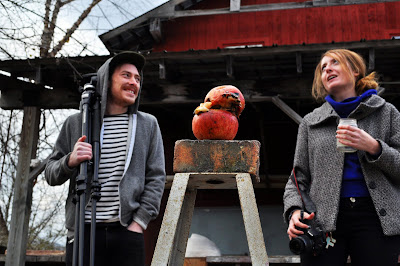
A failed video project in which an apple did not spectacularly explode. (Don Hershey and Erin Fitzpatrick at VSC)

Most of the people that I hang out with are involved in some form of art, music or writing. Even though they are from all over and have very different backgrounds, they do have a certain type of ambition in common. As Clare writes, they’re not after nice things or being famous for the sake of being famous. But I think it’s safe to say that they’d all like to make something kickass and have people know it and benefit from it. They want time to spend producing and time to spend enjoying the things that their friends produce.

My friend Erin Fitzpatrick from the Vermont Studio Center has been doing an interview project that might shed more light on the subject. It’s still in the beginning stages, but stay tuned on Fitzbomb.com to hear about how creative people have responded to her polarizing question, “Do you want to be famous?"


Teaser image of an upcoming video project about rituals.

Sunday, November 27, 2011

Topping Out

Twice-bundled, pre-cut trees.

Ours is not a culture ruled by ritual, but it’s fun to play out the few tattered traditions that remain, those that have hung on despite our penchant for utility and speed. In my experience, they are usually ghosts from a childhood of church-going, nostalgic reconstructions of the past or simply old habits dying hard. My family embarked on one this morning -- hunting for this year’s Christmas tree.

When I was very little, this was a whole day affair involving tractor rides up and down hills of differently spiked firs and pines. In later years, it was a heated argument between my brother and me over the pre-cut trees down by the lodge. We were supposed to alternate each year as to who made the final decision. But, without fail, we could never quite recall the outcome of the previous year. The debate would involve bribes, blackmail, hand-to-hand combat and the parent pity card. It would usually end in tears and one or both of us running off into the endless rows of trees. Today, we made a pact before we left to agree on something as fast as possible, regardless of quality. (What? We're busy!) So we chose a rather ungainly looking mammoth of a tree, fed it through one of those shrink-wrappers, bungee-chorded it to the car and had erected an eleven foot fraser fir in the middle of our living room in less than an hour.

I’m happy to carry on a tradition with pagan, Germanic roots. But it has evolved so far from its pre-Christian beginnings, when the purpose was to show tribute to the tree spirits, that the communing with nature aspect has all but disappeared. When people first started decorating trees, they were not cut down, but ornamented where they stood, so as to preserve their divine inhabitants. Many Scandinavian and Germanic rituals involved trees because the forest was the dominant element in their landscape and they relied heavily upon it for shelter and heat.

Unrelated to the solstice, Saturnalia or any other winter festival, the ancients also had the tradition of mounting an evergreen tree on top of a completed wooden structure. As the last beam was put into place, a tree would be hoisted up so that the spirits of all the timber involved would still have a place to occupy. This ceremony, called “topping out,” is cause for celebration for the workers and has also migrated to the States. I like to think of the tree towering over our couches as topping out the year.