Sunday, November 20, 2011

Pixies Prefer Pixels


As I was looking to Kalan for an image to represent Occupy, New York Magazine was busy casting him for a much bigger role – the poster child of a generation. The article -- “The Kids are Actually Sort of Alright” -- came out this month in NYMag with him on the cover and laid out the lot of American twenty-somethings. The forecast by Noreen Malone, herself of the Millennial generation she was analyzing, was cloudy with only the thinnest of silver linings. The pessimism was amplified by its proximity to the article “P.S. The world is ending this Friday.” More than the many statistics about joblessness (which fail to shock me every time) I was interested in the psychological diagnosis that was offered of us big kids.

We are: idealist, self-confident, floundering, hopeful. Despite the overwhelming circumstantial evidence that says we will fall short in all of the ways that our society usually measures people, we believe that we will succeed in accomplishing our aspirations – abstract and sweeping as they may be. We are alienated from the things we use. We live in a country that doesn’t make many things anymore, so we channel our impulse to create into crafting useless objects like art, crocheted reindeer and blog posts. We may be unemployed but we are culturally wealthy. We have more free, communal resources for communication, entertainment, news and production than we can use. We need less physical paraphernalia because of this. Our valuables are as small and portable as 1s and 0s. They are as transient as we are and as intangible as our goals. Sure it sounds a little like a hokey astrological reading. “You are passionate and headstrong. An unexpected visitor leads to financial gain on the second of the month.” But some of it rings true.

Let’s give our collective character form for a minute. Let’s call him/her Peter Pan. Now perhaps it is easy to see why Kalan fits the bill. A street performance artist, a transient traveler with his band of (lost) puppets, often outfitted in a costume of tights and secondhand ornaments. More oriented toward adventure and stories than a “grown-up” career.

Our generation is playful with gender. Our ideals of masculine and feminine beauty are conflating and more of us are curating our own gender from a combination of traditionally male and female traits. We have all of the sexual freedoms in the world but we are not necessarily using them, perhaps out of narcissism or because we value documentation and analysis over the experiential, or because the old ways of fitting together don’t feel right anymore and it will take time to craft new choreography.

There is a refusal to grow up and settle down with one city, one job or one partner. The Occupy movement has also brought out our drive to fight the pirates. (Those that take more than their share.) Not because we want to take their places but because we want to see the end of pirates altogether. Our fashion has embraced an aesthetic of the cast-off and castaway. To top it off, we can traverse our world in seconds – carrying messages, surfing currents of information and gaining great perspectives from our height. It’s just that, instead of fairy dust, our pixies prefer pixels.


Some new works on mylar that may or may not have anything to do with the above:


Study for Sleeping Beauties, 12"x15"
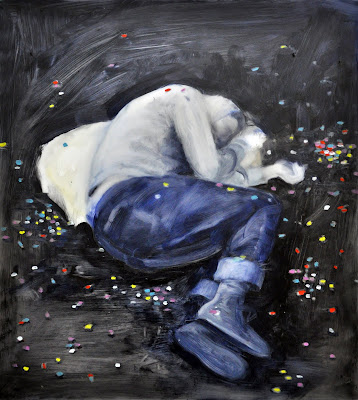

The DJ, 12"x10"


Performance, 10"x15"


Spilt, 10"x12"


Your Place or Mine, 12"x15"

Friday, November 18, 2011

Melon Morning


I just finished up a month long residency at the Vermont Studio Center in Johnson Vermont. The light coming through my window this morning lit the curtain up like a ruby and splashed the walls with melon green and yellow. Sometimes, like writers record snippets of overheard conversation, I collect colors.

Saturday, November 12, 2011

Sleeping Beauties


Laini and I emerged from the Fulton Street subway and turned in slow circles, not sure which way was south with the sun directly overhead. A mailman stopped his cart to ask us where we were headed. “Occupy,” we admitted. He gave us directions to the park and we were off. “If you get a chance,” he called after us, “tell my daughter to come home.”

It was smaller than I’d pictured. I’ve heard others say the same. It’s expanded in our minds through its replication in the media, the kaleidoscopic documentation of each event and the seeds it’s scattered across the globe.

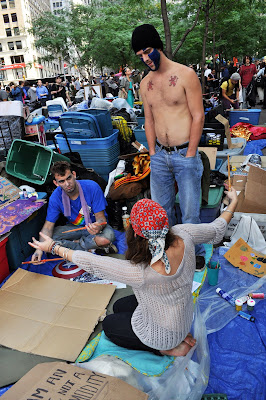
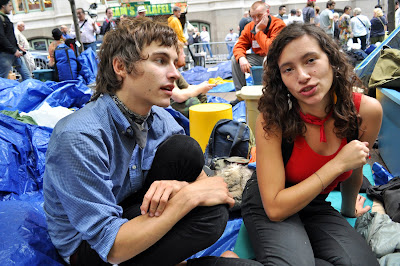
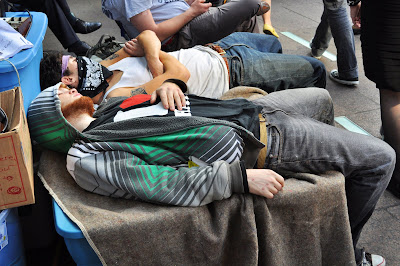
The core group – the sleepers – was an even smaller bunch. You could easily see how much space each one occupied. Their footprints of concave bedding, nested with a small pile of belongings were clumped around the park. They set the example that people could live with little. This was mid-October and the sun was out boosting moral. Although, temperatures have certainly dropped since then and the nights must be brutal.

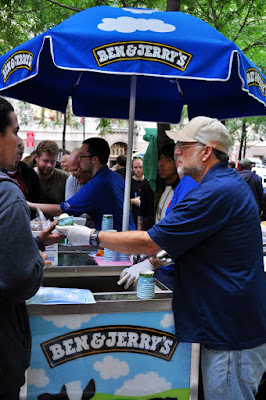
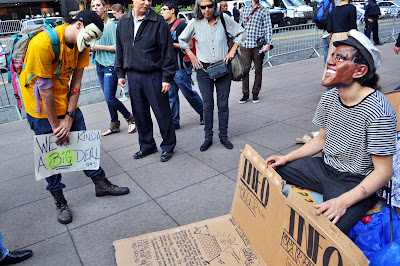
Tents are outlawed in Zuccotti Park, so I wandered through a blue-tarped terrain that was composed of any shelter or support that couldn’t be labeled as such. I was reminded of the time I spent volunteering in the Ninth Ward after Hurricane Katrina. Ours was a tent village in a parking lot with its own self-sufficient infrastructure including facilities in a gutted school building. Outside of these one-block worlds, the environment is entirely different – wasteland or bustling financial center. Inside Zuccotti, the mood was festive, like a music festival campground. Each of the protesters seemed to adopt a role to keep the community organism sustained. A women collected trash. Bins of books were up for borrow. Ben and Jerry themselves set up an ice-cream stand and dished out highly-photographed offerings. The occupiers spent their days working, but in a non-Capitalist sense. They would organize events, participate in protests around the city, repeat and amplify speeches, and even perform puppet shows on the subway. Just being present was productive.

Jerry.

The puppeteer was Kalan, a friend from Oberlin who had often ruffled the feathers of our school, which considered itself unable to be phased by liberal antics, with his performance art. He told me he had been sleeping at Occupy with a few breaks since September 10th. When I asked him how he was doing, he lifted his head slowly and looked at me with big, glassy eyes. “I’m very tired,” he said.

Chilling with Kalan.

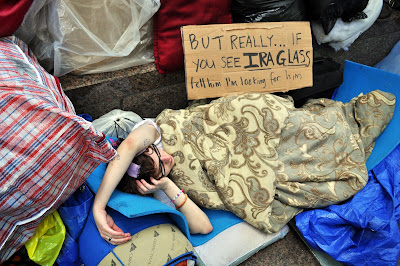
As I weaved in and out of bodies and boxes and bold-lettered signs, I was struck by the intimacy of the space. Without being able to cover themselves fully, the protesters were in a vulnerable position -- belly up in the middle of a city known for chewing up its pilgrims and spitting them out. There was no private space and the site was a magnet for public viewing. Nights they had to fight off cold and city noise for sleep, so many caught mid-day naps when they could. Curled up in the sun, they were the ultimate peaceful protesters. Powerful in the satyagraha (Ghandi’s philosophy of non-violent resistance) sense.


Walking around to read the slogans and pick up the pamphlets meant that you were also stepping gingerly over the arm of a sleeping teenage girl or brushing up against two boys curled up in each other’s arms. The sleeping beauties imbued the space with a seductive charm. Some slept underneath their posters, asking to be documented. Unfortunately, the intriguing layout lured media leeches as well as supporters. Kalan and his friend told me that they had recently been photographed by a British tabloid that claimed the closeness of their bodies was evidence of public sex and drug use on Wall Street. I managed to find the article and the photograph online. But reading the slanderous accusations didn’t sully the beauty of the image. Despite themselves, they had circulated a photo that radiated the pleasure of togetherness and the peace of simple living.

Headline reads: "Sex and drugs on tap, who says it's not a political partaaay?"

Saturday, November 5, 2011

Persephone Down Under


My apartment in Berlin on one of my last afternoons.

The trees are shedding leaves -- cutting their losses -- as the temperature falls and winter storms roll in. These skeletal trunks have a better chance of standing ground against the pileup of heavy snows. With fewer attachments, the burden of the world is easier to bear. Animals, too, pare down their lifestyles. They take to a simpler, stationary mode, conserving resources. It’s hibernation time and what better place to burrow than a small town in northern Vermont, where the local food shop is well supplied with this season’s maple sugar haul, the woodpile is high and the whiskey is stocked.

I am sitting in my studio in Johnson, looking out over the red mill-turned art space and the river. The morning sun is bright as spring water is cold and bathes the town in cool silver, rather than golden, light.

In thinking about the turning of the seasons, the main changeling that comes to mind is Persephone. An over-sheltered child, her mother Demeter, goddess of the harvest, kept her separate from the riffraff of Mt. Olympus. She spent much of her childhood alone, using earth’s topography as her playground. One day, while picking flowers on a hillside, the ground opened up in front of her and she was pulled down to Hell by the king of the underworld. Hades forced her to stay by his side and rule the dominion of the dead. Much to her surprise, the role suited her and she grew into a strong and confident queen. Old friends that visited her there were taken aback by her severity and serenity. But her mother was hysterical with grief and caused a devastating draught. This forced the hand of Zeus, Persephone’s father. He brought Persephone back up to the light. But before she left, Hades fed her a handful of pomegranate seeds. The fates had long ago decreed that anyone who ate or drank in the underworld was doomed to spend eternity there. Therefore, although the lands flourished when Persephone rose to greet them, they retracted again in the winter months (one for each seed) when she returned to claim her thrown in Hell.

Many of our life patterns are cyclical. I’ve been thinking a lot lately about how the process of making art works in the round. For me, the yin-yang of experiencing and recording keeps my gears turning. First, there is a period of living fully -- gathering new experiences and perspectives and sensations. Then, there is a period of digestion, reflection and, hopefully, birth. (Or the other way around because this is a chicken/egg type of thing.) This Vermont season is a time for patience and production. A lot of looking for reflections in blank surfaces – the iced-over river, notebook paper, white canvas.


My studio at the Vermont Studio Center where Jeff and Don are gearing up for the Halloween festivities.


They're ready now. (Photo by Erin Fitzpatrick)

Tuesday, October 18, 2011

Let The Right One In

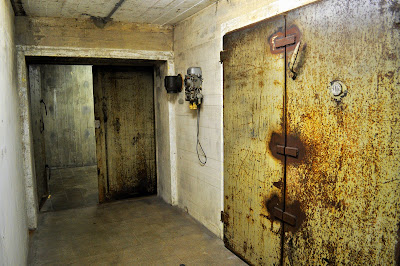
In order to be safe you have to be separate. Either enclosed or excluded from the turbulent, unpredictable outside world. That’s the price. To stay exposed under earth’s vaulted sky is to risk it cracking up and falling down on your head. And in 1942, no one in Germany could deny the sky was falling. So they built a place apart. A building so sturdy that after the firebombs of WWII and many decades of the city growing up and changing around it, it stands as impervious as ever. Only the faint moonscape on its concrete shell betrays the trouble it’s seen. Most of the other bunkers from this era have been torn down, but the amount of explosives needed to level this one would take its residential neighbors down with it. Destroying its world would cause a rift in ours.

The entrance i.e. what I could see before they made me put my camera away. Still cool.

The bunker has had many names. My personal favorite being ‘Bananabunker,’ but we’ll get to that. Layers of history haunt this mammoth, 5,000 square-meter structure. Each with its own set of colorful ghosts. The haunts don’t have a way out -- the walls are two-meters thick with a three-meter ceiling. After serving its original purpose as a war bunker, the building was later converted into a prison by the Red Army and then used as a storage space for Cuban fruit. It played host to one of the most extreme gay fetish clubs of all time and, since 2008, has been transformed into a private museum. The artwork that resides there now mediates the many voices of its past and is charged by them.

When Karl Bonatz designed the building originally, it was to be a cog in the Nazi’s master machinery of Germania, the future capitol of the world as envisioned by Albert Speer. It was almost windowless, with low ceilings at 2.3 meters and 180 almost identical concrete rooms. Built to house 1,500 people in the event of air strikes, it held up to 4,000 at the height of the war. Or at least that was the figure quoted to me by my sprightly German tour guide as we wandered the space with the eleven other international voyeurs. (Tours are always twelve people at a time, scheduled weeks in advance on their website.) Inside, the walls are still stenciled with spray-painted regulations and strung with glow-in-the-dark arrows and lines to direct refugees in case of a power outage.

There are many buildings in Germany that were constructed to defend against an enemy, but are later occupied by that very group of people. The Soviets used this bunker after 1945 to house German prisoners of war. In the 1950s, it became a storage space for dried fruit, oranges and bananas because of its perma-cool climate. From 1992-1996 it gained the nickname “hardest club on earth.” Fetish, fantasy, drugs and techno music came out to play in its shadowy caves. Some rooms were painted black for that which required an even greater cover of darkness. However, the ventilation system had broken and been stripped years before and oxygen was hard to come by amid the smoke, drugs and fog machine plumes. Besides the toxic air, there were many police raids that eventually led to its closing. But no need to mourn the S&M muse, it alighted on Berghain and this club has held the torch since.

In 2003, Christian Boros and his wife bought the bunker to display their art collection and began a massive makeover. Forty of the 120 rooms and 1,800 tons of concrete were removed. Now some ceilings stretch to 13 meters and the space resembles more of a 3-D labyrinth than a prison. (You know, like if you were a giant snake you could wind in and out of its cutout walls and open ceilings.) For their first exhibition that has been on view since 2008, the Boros’ installed 80 works. Many of the art pieces were made specifically for the bunker or adapted by the artists to fit the space. The artists were able to choose which rooms they worked in and curate the show themselves.

It is a phenomenal space in which to experience art. With all of the different melodies from its history ringing in your ears, the pieces pick up on one or another tonal phrase and resonate. For instance, Anselm Reyle’s cart uses the same neon paint that clings to the walls from the 40’s and Katja Strunz’s wooden paper airplane-like sculptures play in and around old spray-painted text. Though for some, it is more about what you can’t hear. Kris Martin’s bell that swings over the foyer is clapper-less and titled “For Whom.” We weren’t allowed to take photographs inside, but there are some beautiful ones here and it’s all about walking the walk anyway.

The icing on top of this layered cake is a colossal glass penthouse. Because the Boros’ were not allowed to make changes to the façade of the bunker itself, they built their home above it. The view must be spectacular – both of the city and of the hundreds of artworks that grace their private walls, including what my guide estimates to be 40 Elizabeth Payton paintings.

Odin, king of the Norse gods, has a grand fortress too. It is also both a military establishment and a palace of wonders with spear-shafts for rafters and a roof of golden shields like shingles. It holds hundreds of rooms and is topped with the tree Lærad just as the Berlin bunker is crowned in foliage. The Valkyries choose which men die in battle and take the bravest here. Once they are residents of the great hall, the warriors’ days consist of fighting each other until they lie in a hewn pile on the lawn, being resurrected just before dinner time, dining and drinking the night away and then, if they’re lucky, getting to know one of those maidens of death a little better. The boar that they feast on is also whole again and ready for the spit come morning.

A palace of ghosts. Crowned by German art world royalty. Who wouldn’t want in? Christian sends invitations to the boldest of artists to take up residence. To our culture’s risk takers. Those that lead reckless charges against the ramparts of society’s standards or venture daringly into the unknown.

Thursday, October 13, 2011

Magpies Nest in Neon

Instead of going door-to-door in search of the ideal space to call home, the artists that started the Agora Collective decided to take matters into their own hands. This summer, they began to renovate an industrial building in Neukölln with a floor for exhibitions, one for co-working and a loft for visitors to stay. They then began filling it up with the people and projects and ideas they wanted to be surrounded by. “Be the change you want to see in the world.”

Eight of my paintings on mylar shown at the Montenegro Musik Raum.


On Monday, the musical branch of their space opened in an explosion of creative activity. Dylan Aiello had been working on transforming his neighboring flat into Montenegro – a practice and performance venue. The opening, sponsored by Airbnb, was composed of performances ranging from burlesque to jazz, classical recitals to improvised jam sessions. Chattering crowds of attendees, warm lights and the sounds of foot-stomping blues spilled out onto the streets.


A defining feature was the mammoth bar Dylan had managed to materialize inside the space – though it dwarfs the studio doors. For the opening, he outfitted it as a Wunderkammer. My paintings nested in its old wood shelves for the evening. He filled the middle section with an odd assortment of found treasures and lit the piece with jerry-rigged bulbs and colored lamps in various stages of disrepair. I had also painted the glass panels on the bathroom doors and a video artist projected his colorful abstractions onto the ceiling.

Dylan winds up an old film.


The evening winds down.

It was the opposite of the white-cube gallery experience. There was no line between where my work ended and the hanging clock gears began. I am not sure what this means for showing my work in the future, but when all was said and hung, my paintings felt very much at home.

I painted a shower-boat on the bathroom doors.


One of my paintings on display: Round Table, Oil on Mylar, 12inx15in, 2011

Sunday, October 2, 2011

Land of the Lost

Please don’t climb this low, crumpled fence and wander around the abandoned amusement park crisscrossed with gangplanks and littered with fallen dinosaurs, swan-shaped paddleboats and Viking ships. Just ignore the Ferris wheel that rises out of the forest like a candy-colored beanstalk.

The woods running along Treptower Park are punctuated with: “Privatgrundstück: Betreten verboten” signs. Based on how these are interpreted by Berlin youth, I’m pretty sure this translates as: “I dare you: It’s really cool in here.”

It felt more familiar than it should, sprinting from dilapidated ticket booth to concession stand, keeping out of sight from the road. It took me a while to realize that a scene from Hanna, the Joe Wright film, had been shot here. In the movie, they call it Grimm’s Amusement Park and it is the supposed abode of the descendants of the Brothers Grimm. The young protagonist, Hanna, battles her nemesis up and down its old rollercoaster tracks and through its railway tunnels. The caretaker, a circus clown, is murdered brutally and theatrically in his gingerbread-style cottage on the grounds. But it doesn’t take an outside source to color this place, which is really Spreepark in Planterwald, Berlin, in a macabre light. It’s a graveyard of playthings. Someone’s forgotten to pick up his toys. It begs the question, what called him away so quickly and why hasn’t he returned?

The story doesn’t have a happy ending. We can pick it up when the East Berlin fairgrounds were in shambles after the wall fell. The Wittes, a family of Austrian carnival performers and owners, invested in the site in 1991. The place transformed under the direction of Norbert Witte, the father, from a handful of scattered attractions into a full-fledged carnival wonderland. Not easily satiated, Norbert was continually adding a new stage here and a few water rides there. A whole Western town and English village sprung up according to his vision. The park thrived for almost a decade and then faltered when the city pulled thousands of parking places and the admission price rose to support each new addition. By 2001, the family filed for bankruptcy with debts approaching fifteen million euros.

To cope with their loses, Norbert decided to open another amusement park in Peru, siphoning off rides and supplies from Germany on the pretext of having them repaired in South America. But this park never got off the ground and soon his wife was having trouble feeding their five children. When things got desperate, Norbert decided to go through different channels. He packed 167 lbs of cocaine inside the flying carpet carousel and arranged for it to ship back to Germany. He left his oldest son, twenty-one year old Marcel, in charge of the transaction and headed to Germany to receive it. But the enchanted rug never arrived. One of the dealers was an undercover agent and both Norbert and his son were arrested. Norbert was sentenced to seven years in Germany and did four before he was released. In 2006, Marcel was sentenced to 20 years in Peru and is currently serving his time in one of the toughest prisons in the world. Norbert, though his wife left him, is still living in a trailer on the grounds of the park, fabricating wooden stalls for festivals.

The Grimm Brothers recorded a story called, “Godfather Death,” about a father with too many sons and too few resources. When the thirteenth son is born, in desperation, this father runs out onto the road to find a godfather to adopt this boy. At first, he encounters God who offers to provide care and happiness for the boy. But the father refuses out of spite because God has chosen to give so much to the rich and deprive the poor. So God goes on his way.

Next he encounters the Devil, who offers to give the boy gold and worldly pleasures if he is chosen as the godfather. But the father refuses the Devil as well, accusing him of lying to men and leading them astray.

Then the father meets Death on the road. Death argues that he alone treats everyone equally, rich and poor, old and young. The father is persuaded by this and, thinking Death a just guardian, gives his son into his care. Death provides the boy with a healing herb so that he can become a great physician. But the boy is always beholden to Death’s whim as to whom he is allowed to save and whom Death will claim for himself.

One day, the young doctor is called into the King’s castle to care for his daughter. The boy immediately falls in love with the princess, but Death makes it clear that she has been marked to die. Overcome with his feelings for the girl, the doctor gives her the healing herb anyway and delights in watching her cheeks regain their rosy glow. But Death is angry and leads him down to an underground cavern lined from floor to ceiling with candles representing every life on earth. Full, tall ones for healthy children and small frail ones for the old. The doctor asks to see his own candle. When Death points with a long, bony finger to a sputtering stub, he gasps. He pleads with Death to light another one for him, lest the tiny flame fail. Death reaches for a new candle but purposefully fumbles the light and the boy falls dead to the ground.

The ponds and grasses around the giant Ferris wheel in Spreepark are scattered with thousands of light bulbs. They once ran around its face in brilliant, multicolored flames. Now extinguished, they clump together in the marshy areas like overgrown frog eggs.