Tuesday, October 18, 2011

Let The Right One In

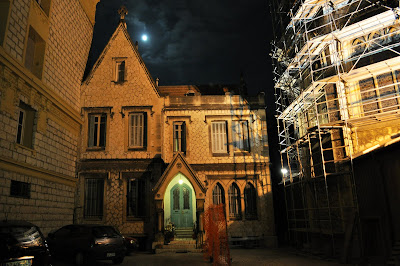
In order to be safe you have to be separate. Either enclosed or excluded from the turbulent, unpredictable outside world. That’s the price. To stay exposed under earth’s vaulted sky is to risk it cracking up and falling down on your head. And in 1942, no one in Germany could deny the sky was falling. So they built a place apart. A building so sturdy that after the firebombs of WWII and many decades of the city growing up and changing around it, it stands as impervious as ever. Only the faint moonscape on its concrete shell betrays the trouble it’s seen. Most of the other bunkers from this era have been torn down, but the amount of explosives needed to level this one would take its residential neighbors down with it. Destroying its world would cause a rift in ours.

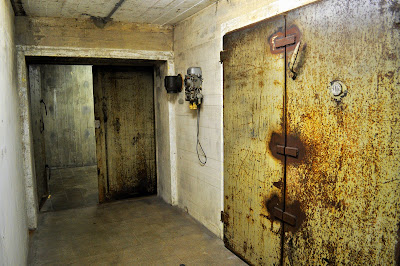
The entrance i.e. what I could see before they made me put my camera away. Still cool.

The bunker has had many names. My personal favorite being ‘Bananabunker,’ but we’ll get to that. Layers of history haunt this mammoth, 5,000 square-meter structure. Each with its own set of colorful ghosts. The haunts don’t have a way out -- the walls are two-meters thick with a three-meter ceiling. After serving its original purpose as a war bunker, the building was later converted into a prison by the Red Army and then used as a storage space for Cuban fruit. It played host to one of the most extreme gay fetish clubs of all time and, since 2008, has been transformed into a private museum. The artwork that resides there now mediates the many voices of its past and is charged by them.

When Karl Bonatz designed the building originally, it was to be a cog in the Nazi’s master machinery of Germania, the future capitol of the world as envisioned by Albert Speer. It was almost windowless, with low ceilings at 2.3 meters and 180 almost identical concrete rooms. Built to house 1,500 people in the event of air strikes, it held up to 4,000 at the height of the war. Or at least that was the figure quoted to me by my sprightly German tour guide as we wandered the space with the eleven other international voyeurs. (Tours are always twelve people at a time, scheduled weeks in advance on their website.) Inside, the walls are still stenciled with spray-painted regulations and strung with glow-in-the-dark arrows and lines to direct refugees in case of a power outage.

There are many buildings in Germany that were constructed to defend against an enemy, but are later occupied by that very group of people. The Soviets used this bunker after 1945 to house German prisoners of war. In the 1950s, it became a storage space for dried fruit, oranges and bananas because of its perma-cool climate. From 1992-1996 it gained the nickname “hardest club on earth.” Fetish, fantasy, drugs and techno music came out to play in its shadowy caves. Some rooms were painted black for that which required an even greater cover of darkness. However, the ventilation system had broken and been stripped years before and oxygen was hard to come by amid the smoke, drugs and fog machine plumes. Besides the toxic air, there were many police raids that eventually led to its closing. But no need to mourn the S&M muse, it alighted on Berghain and this club has held the torch since.

In 2003, Christian Boros and his wife bought the bunker to display their art collection and began a massive makeover. Forty of the 120 rooms and 1,800 tons of concrete were removed. Now some ceilings stretch to 13 meters and the space resembles more of a 3-D labyrinth than a prison. (You know, like if you were a giant snake you could wind in and out of its cutout walls and open ceilings.) For their first exhibition that has been on view since 2008, the Boros’ installed 80 works. Many of the art pieces were made specifically for the bunker or adapted by the artists to fit the space. The artists were able to choose which rooms they worked in and curate the show themselves.

It is a phenomenal space in which to experience art. With all of the different melodies from its history ringing in your ears, the pieces pick up on one or another tonal phrase and resonate. For instance, Anselm Reyle’s cart uses the same neon paint that clings to the walls from the 40’s and Katja Strunz’s wooden paper airplane-like sculptures play in and around old spray-painted text. Though for some, it is more about what you can’t hear. Kris Martin’s bell that swings over the foyer is clapper-less and titled “For Whom.” We weren’t allowed to take photographs inside, but there are some beautiful ones here and it’s all about walking the walk anyway.

The icing on top of this layered cake is a colossal glass penthouse. Because the Boros’ were not allowed to make changes to the façade of the bunker itself, they built their home above it. The view must be spectacular – both of the city and of the hundreds of artworks that grace their private walls, including what my guide estimates to be 40 Elizabeth Payton paintings.

Odin, king of the Norse gods, has a grand fortress too. It is also both a military establishment and a palace of wonders with spear-shafts for rafters and a roof of golden shields like shingles. It holds hundreds of rooms and is topped with the tree Lærad just as the Berlin bunker is crowned in foliage. The Valkyries choose which men die in battle and take the bravest here. Once they are residents of the great hall, the warriors’ days consist of fighting each other until they lie in a hewn pile on the lawn, being resurrected just before dinner time, dining and drinking the night away and then, if they’re lucky, getting to know one of those maidens of death a little better. The boar that they feast on is also whole again and ready for the spit come morning.

A palace of ghosts. Crowned by German art world royalty. Who wouldn’t want in? Christian sends invitations to the boldest of artists to take up residence. To our culture’s risk takers. Those that lead reckless charges against the ramparts of society’s standards or venture daringly into the unknown.

Thursday, October 13, 2011

Magpies Nest in Neon

Instead of going door-to-door in search of the ideal space to call home, the artists that started the Agora Collective decided to take matters into their own hands. This summer, they began to renovate an industrial building in Neukölln with a floor for exhibitions, one for co-working and a loft for visitors to stay. They then began filling it up with the people and projects and ideas they wanted to be surrounded by. “Be the change you want to see in the world.”

Eight of my paintings on mylar shown at the Montenegro Musik Raum.


On Monday, the musical branch of their space opened in an explosion of creative activity. Dylan Aiello had been working on transforming his neighboring flat into Montenegro – a practice and performance venue. The opening, sponsored by Airbnb, was composed of performances ranging from burlesque to jazz, classical recitals to improvised jam sessions. Chattering crowds of attendees, warm lights and the sounds of foot-stomping blues spilled out onto the streets.


A defining feature was the mammoth bar Dylan had managed to materialize inside the space – though it dwarfs the studio doors. For the opening, he outfitted it as a Wunderkammer. My paintings nested in its old wood shelves for the evening. He filled the middle section with an odd assortment of found treasures and lit the piece with jerry-rigged bulbs and colored lamps in various stages of disrepair. I had also painted the glass panels on the bathroom doors and a video artist projected his colorful abstractions onto the ceiling.

Dylan winds up an old film.


The evening winds down.

It was the opposite of the white-cube gallery experience. There was no line between where my work ended and the hanging clock gears began. I am not sure what this means for showing my work in the future, but when all was said and hung, my paintings felt very much at home.

I painted a shower-boat on the bathroom doors.


One of my paintings on display: Round Table, Oil on Mylar, 12inx15in, 2011

Sunday, October 2, 2011

Land of the Lost

Please don’t climb this low, crumpled fence and wander around the abandoned amusement park crisscrossed with gangplanks and littered with fallen dinosaurs, swan-shaped paddleboats and Viking ships. Just ignore the Ferris wheel that rises out of the forest like a candy-colored beanstalk.

The woods running along Treptower Park are punctuated with: “Privatgrundstück: Betreten verboten” signs. Based on how these are interpreted by Berlin youth, I’m pretty sure this translates as: “I dare you: It’s really cool in here.”

It felt more familiar than it should, sprinting from dilapidated ticket booth to concession stand, keeping out of sight from the road. It took me a while to realize that a scene from Hanna, the Joe Wright film, had been shot here. In the movie, they call it Grimm’s Amusement Park and it is the supposed abode of the descendants of the Brothers Grimm. The young protagonist, Hanna, battles her nemesis up and down its old rollercoaster tracks and through its railway tunnels. The caretaker, a circus clown, is murdered brutally and theatrically in his gingerbread-style cottage on the grounds. But it doesn’t take an outside source to color this place, which is really Spreepark in Planterwald, Berlin, in a macabre light. It’s a graveyard of playthings. Someone’s forgotten to pick up his toys. It begs the question, what called him away so quickly and why hasn’t he returned?

The story doesn’t have a happy ending. We can pick it up when the East Berlin fairgrounds were in shambles after the wall fell. The Wittes, a family of Austrian carnival performers and owners, invested in the site in 1991. The place transformed under the direction of Norbert Witte, the father, from a handful of scattered attractions into a full-fledged carnival wonderland. Not easily satiated, Norbert was continually adding a new stage here and a few water rides there. A whole Western town and English village sprung up according to his vision. The park thrived for almost a decade and then faltered when the city pulled thousands of parking places and the admission price rose to support each new addition. By 2001, the family filed for bankruptcy with debts approaching fifteen million euros.

To cope with their loses, Norbert decided to open another amusement park in Peru, siphoning off rides and supplies from Germany on the pretext of having them repaired in South America. But this park never got off the ground and soon his wife was having trouble feeding their five children. When things got desperate, Norbert decided to go through different channels. He packed 167 lbs of cocaine inside the flying carpet carousel and arranged for it to ship back to Germany. He left his oldest son, twenty-one year old Marcel, in charge of the transaction and headed to Germany to receive it. But the enchanted rug never arrived. One of the dealers was an undercover agent and both Norbert and his son were arrested. Norbert was sentenced to seven years in Germany and did four before he was released. In 2006, Marcel was sentenced to 20 years in Peru and is currently serving his time in one of the toughest prisons in the world. Norbert, though his wife left him, is still living in a trailer on the grounds of the park, fabricating wooden stalls for festivals.

The Grimm Brothers recorded a story called, “Godfather Death,” about a father with too many sons and too few resources. When the thirteenth son is born, in desperation, this father runs out onto the road to find a godfather to adopt this boy. At first, he encounters God who offers to provide care and happiness for the boy. But the father refuses out of spite because God has chosen to give so much to the rich and deprive the poor. So God goes on his way.

Next he encounters the Devil, who offers to give the boy gold and worldly pleasures if he is chosen as the godfather. But the father refuses the Devil as well, accusing him of lying to men and leading them astray.

Then the father meets Death on the road. Death argues that he alone treats everyone equally, rich and poor, old and young. The father is persuaded by this and, thinking Death a just guardian, gives his son into his care. Death provides the boy with a healing herb so that he can become a great physician. But the boy is always beholden to Death’s whim as to whom he is allowed to save and whom Death will claim for himself.

One day, the young doctor is called into the King’s castle to care for his daughter. The boy immediately falls in love with the princess, but Death makes it clear that she has been marked to die. Overcome with his feelings for the girl, the doctor gives her the healing herb anyway and delights in watching her cheeks regain their rosy glow. But Death is angry and leads him down to an underground cavern lined from floor to ceiling with candles representing every life on earth. Full, tall ones for healthy children and small frail ones for the old. The doctor asks to see his own candle. When Death points with a long, bony finger to a sputtering stub, he gasps. He pleads with Death to light another one for him, lest the tiny flame fail. Death reaches for a new candle but purposefully fumbles the light and the boy falls dead to the ground.

The ponds and grasses around the giant Ferris wheel in Spreepark are scattered with thousands of light bulbs. They once ran around its face in brilliant, multicolored flames. Now extinguished, they clump together in the marshy areas like overgrown frog eggs.

Monday, September 26, 2011

Devil’s Mountain


Far beneath it all lies a network of concrete hallways that spreads like fingers through the earth. Light can’t make it down there anymore and the structure would have collapsed a long time ago if it hadn’t been cursed with an invincible skeleton. So when bombing didn’t work, they buried it alive.

This was the college that Albert Speer designed for Nazi military technology and what they piled on its grave were the remains of 400,000 German homes. The Allies carted the rubble in 80 truckloads a day until the pile was the highest point in Berlin. It’s called Teufelsberg or Devil’s Mountain.

Kiefer’s words, “Over your city grass will grow,” come to mind. A hardscrabble carpet of green has managed to take hold above the stone. And on top of this, during the Cold War in what was then the British Sector of West Berlin, the Americans erected an intelligence center. Three bulbous metal towers loom on its summit. Three great eyes with satellite retinas were trained unblinkingly on the East. They’ve been abandoned since two years after the wall fell. Today their ruined shells peel like birch bark.

And this evening, on the very top of this many-layered place, a boy stands with a kite that stretches far up into the darkening sky.

I am here with my roommate. Helles beer (which means bright in German but still feels appropriate) in hand, we climb to the top for a view of the city. Around us everything that can be lifted is hoisted into the sky. Toy gliders, kites, remote controlled airplanes. A man reclines alongside his fuchsia paraglider and sews on another neon yellow triangle. I look out over Berlin, spotting the Fernsehturm (TV tower) that I wrote about when I first arrived and am able to spin the rest of the city out from there. The wind takes up the smell of hash that the teenagers use to gain altitude. High. The people have chosen to elevate this dark place and not look down.

It should be said that David Lynch tried to buy the land in order to build a Happiness College.

Sure, he could be here. Trapped with the rest of the damaged things in the underground pit. Dante’s Devil would fit the bill. Once in God’s favor, he tried to overtake the Lord and was thrown out of Heaven. The impact he made as he fell through the earth created 9 circles of Hell and stuck him in the deepest one. Dante’s Satan is a giant beast, trapped for eternity in a layer of ice that the slow beating of his wings continually refreezes. The others in his realm are frozen immobile, their bodies contorted as grotesque ice sculptures. The debris that was expelled from the earth when he crashed formed the mountain of Purgatory – as high as Hell is deep. A pile of rubble made from the consequence of great sin. Something to climb to get perspective.

Monday, September 19, 2011

She Taketh Away


Allison Fall performing in ANTINOMIES: GEGENSÄTZE at gallery OPEN on Sunday

I saw two performances at galerie OPEN yesterday. In both, women destroyed their work.

Madeline Stillwell broke through and demolished the white box shelter that she had built for “hibernation.” Allison Fall filled and stacked the porcelain dishware she’d cast until the pile was so heavy that each new plate broke the one underneath it with the bright scream of china. They climbed on top of their Towers of Babel until they laid them flat, and both creator and creation lay mumbling on the floor.

Madeline Stillwell performing in ANTINOMIES: GEGENSÄTZE at galerie OPEN on Sunday

Neither woman seemed to have much regard for keeping her body intact. Boundaries between work and worker were breached through Madeline’s covering herself in the clay that enforced her structure and gargling clay water. Allison covered herself and her sculptures in coco bean pigment and spit up porcelain goo. The body’s fate was locked in with that of the work and it was clear that the entropy of each piece would play out until there was no more energy to work through. When Allison sat high up on a column of shattering porcelain, I couldn’t help but gasp as glass and flesh came down in a tangled pile.

There were aspects of ritual in each – especially in Allison’s piece. She started in a pure white dress holding a cup up to us as an offering and prostrating herself on the floor. Before she took each new basin of liquid porcelain, she would hold it up as if in recognition of a sacrifice.

We could think of these artists (or artists in general for that matter) as the creators of their own small universes. The construction of the sculptures was the generative half of their duties and what we witnessed was the part where she taketh away. What was white and whole became sullied and oozing. We came full circle and were left to wonder, what goddess destroys her children?

The answer, of course, is most of them. Goddesses from all over, especially in polytheist religions, are not just the creators, but masters of destruction as well. I see Madeline and Allison’s performances as a rejection of the pure Virgin Mary style maker who is at odds only with exterior world evils, and relating to the complex feminine archetype of the goddess who deals in life and death and doesn’t always have her shit together.

Since we are in Germany, we can look to Freyja. She takes care of the love stuff, fertility and childbirth, but she also commands the Valkyries who chose which men die on the battlefield and watch over them in the Realm of the Gods. She is a warrior but often finds herself broken by the long absences of her husband and is known for crying red gold tears. To cope, she finds other lovers or shape shifts into different forms in which she wanders earth in search of him.

Saturday, September 17, 2011

You Can’t Take It With You

Ever met a Cephalophore? I hadn’t either until I happened upon one last week chilling with his angel posse on top of some griffins and a dwarf. They were on the façade of Notre Dame along with so many other miraculous creatures it made your head spin. Dennis (which is the name of this particular Cephalophore) looked quite contented, regal even, holding his head in his hands and looking down on me with a slight patronizing smirk.

The pagans beheaded this Parisian bishop on Montmartre – a sacred site for them that is now one of Paris’ bustling cultural hoods. Dennis was undaunted by this setback, however. He picked up his noggin and carried it for miles up to the top of the hill, preaching all the way. A pretty unique way to go, one would think. However, Dennis is in good company with a slew of other saints that took lifelessness on their own time scale. Some finished the passage they were reading before laying down to rest (true nerds, these). A young boy waited for his dad to get home so that he could bring the head to his mom for a kiss. I know these dead men walking were impressive displays of the power of Christian faith above polytheism and all, but I have to ask. What’s more pagan than that?

Wednesday, September 14, 2011

Black Madonna

Last week my mom and I traveled to some of France’s hot spots – those places where people have been drawn for centuries. Power centers strong enough that just the mention of them floods the mind with romantic notions, visions of the moon seen through a knot of gnarled vines and grand palaces upholstered with deep plums and burgundies.


Paris is a gorgeous tangle of tributes to itself. Each one is an attempt to prove its particular love to the city. Navigating through the gem-encrusted sediment of all those monuments, architectural acrobatics and displays of power, as well as the buzz of the live hive that continues to build it higher, one wonders what’s beneath it all? What’s the source?


When you make your way towards one of the world’s great treasures, it’s hard to feel anything but the pace of the multi-lane tourist highway that’s been constructed to herd as many bodies to and from the site as possible. The roads you walk have been trampled flat by a constant stampede of people hungry for awe. When your turn comes, you buy a ticket, you approach said wonder and you have a small handful of seconds to be or to not be wowed before you are pushed out of the way by an entitled German spinster. But this is da Vinci’s Lady with an Ermine! And I didn’t get a chance to see the brush strokes!


On the fast-track tour of world wonders, I find myself peering behind strips of loose wallpaper and squinting between fence rails to see how a night light animates a messy backyard. When you find the thing that makes your heart race, instead of scheduling a time slot to have that particular sensation, you don’t have to share the energy with anyone. You get to revel in the thrill of the hunt. There is an intimate trade of your lavish affections for its energizing spark.


The big attractions have to work so hard to please each of the thousands of pilgrims in turn, to still have something to give the last stragglers that run breathless though the Louvre at closing time. The Mona Lisa has to have such steely reserve to keep her smile steady and hold onto her secret even when, in the mid-afternoon’s cacophonous crowds and claustrophobic jostling, it would be such a relief to toss it into the sea of greedy camera lenses and be done with it. But she holds it close so that she can present it again the next morning, all shiny, dark and whole.


We took a train to the south through the French countryside and along the ragged, sun-soaked coast. I don’t feel like I got a particularly pure draught of the French landscape, since, when we finally offered ourselves prostrate to the sun, we were on a manicured beach where our moves had been choreographed to minimize exertion long ago. Plush beach chairs and shade-chasing umbrellas. Beautiful boys with trays of sweet liquors that asked you if there was anything else they could do for you. But I could sense the nature of the place lapping at the shores of all the landscaping and human niceties. It was there in the rocky shallows where the water rose from ankle-height to wrap itself around your thighs and take you down in seconds. You could taste it in the thick, savory brine of the sea.

I happened to be reading a novel where the characters were conducting thorough, in-depth studies of the gods, demigods and magic properties of Provence. This was very fortunate for me, seeing as though it made for much less digging myself. Because, let’s face it, the land is really rocky. And I was on vacation.


After a particularly rigorous period of field research and before they attempted an involved summoning spell of a local goddess, my characters took a vacation to France’s south coast. This meant that I had the extreme pleasure of floating in and out of their beach trip and my own. The quality of light in each and the unforgiving, pebbled beaches were indivisible. Topless French woman would walk onto one shore and lay down in another. I alternated from letting the waves hypnotize me and reading sentences like “(She) watched the sea foam draw webs and Hebrew letters on the surface of the water and then erase them again.” I fell back more heavily into my own beach chair when my rumbling stomach suggested that the local rose we’d been gulping down all afternoon hadn’t quite made it to my bloodstream, at which point I would venture out into the crowded, unedited streets for a glass of my own.

“Like wine, Provencal magic had its own distinctive terroir. It was rich and chaotic and romantic. It was a night-magic, confabulated out of moons and silver, wine and blood, knights and fairies, wind and rivers and forests. It concerned itself with good and evil but also with the vast intermediate realm in between, the realm of mischief.” (Lev Grossman, The Magician King, Pg 214)


Apparently there was also a strong thread of “mother-magic” in the region. Early stuff, possibly stemming from Cybele, Diana and Isis. There was a local goddess who reigned over the spheres of earth magic, sex and childbirth. Her face was always half in shadow. She was subsumed by the Christian Mary much later but not entirely diffused. The deeper the researchers looked into the old stories of the region, the landscape and its artwork, the more they saw her darker visage glow through Mary’s mask.

“(The) goddess dealt in gapes and olives, the dark, intense fruit of hard, gnarled trees and vines. And she had daughters too: the dryads, ferocious defenders of the forests. The goddess was warm, even humorous, and loving, but she had a second aspect, terrible in its bleakness: a mourning aspect that she assumed in winter, when she descended to the underworld, away from the light… A Black Madonna: the blackness of death, but also the blackness of good soil, dark with decay, which gives rise to life.” (Grossman, 325)